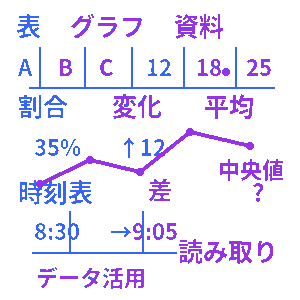
What is the free Tables and Data Reading Quiz?
The Tables and Data Reading Quiz is a free 4-choice web app for practicing how to read original tables, charts, timetables, experiment records, and short data materials.
All questions, answer choices, explanations, tables, graphs, and short reading materials are created independently for this app. They are not copied from textbooks, workbooks, entrance exams, official PDFs, school handouts, or commercial problem collections.
For elementary school to junior high school learners
The quiz starts with simple table lookup and comparison, then moves to bar charts, line graphs, percentages, schedules, experiment records, multi-source materials, and junior-high-style data analysis.
The goal is to build the habit of checking titles, headers, axes, labels, units, totals, differences, ratios, and trends before choosing an answer.
Course lineup
- 10-question basics mix
- 20-question table reading
- 20-question bar charts and histograms
- 20-question line graphs and changes
- 20-question ratios and percentages
- 20-question timetables and schedules
- 20-question experiment and observation data
- 30-question multi-source materials
- 50-question junior high statistics and trends
- 100-question master challenge
Dynamic hints with diagrams
Hints change for each question. They explain how to read the current type of material, such as finding a row and column, comparing bar heights, reading a line graph, calculating a percentage, or sorting data for median and range.
My Page records challenge history, best scores, and often missed questions, making repeated review easier.
What students can practice here
This app is built for short, repeated practice. Students read a small original material, choose the best answer, and then use the hint to check where they should have looked.
The materials include tables, bar charts, line graphs, pie charts, timetables, experiment records, frequency tables, and scatter plots. The questions ask for values, totals, differences, percentages, changes over time, trends, and statements that are supported by the data.
Useful for home study and classroom review
Because the questions are short, they can be used for a warm-up, a quick review after learning graphs, or extra practice for students who want to get used to reading data carefully.
Teachers and families can also use the course names to choose the focus: basic table reading, graph reading, percentages, schedules, experiments, multiple materials, or junior-high data analysis.
Unofficial and original-content notice
- This site is not an official website of any ministry, examination organization, school, university, publisher, cram school, or testing body.
- This site has not received approval, certification, supervision, or partnership from any organization or company.
- The questions are not reproductions of textbooks, reference books, workbooks, standardized tests, entrance exams, qualification exams, proficiency tests, or mock exams.
- The questions, choices, explanations, tables, charts, and reading materials are independently created.
- Names of exams, qualifications, organizations, schools, and companies belong to their respective rights holders.
- Please check official websites for formal curriculum, entrance exam, test, and teaching material information.
- If there is a rights-related issue, please contact us: Contact form


 URL copy
 Facebook
 Twitter