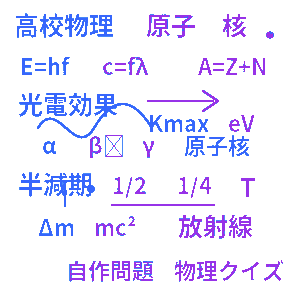
Free High School Physics Atomic Quiz
The High School Physics Atomic Quiz is a free, unofficial, game-like web app for practicing atomic physics topics with original 4-choice questions.
The app covers atoms, nuclei, photons, the photoelectric effect, energy levels and spectra, radioactive decay, half-life, and mass-energy relations. The questions, choices, hints, and diagrams are created independently for this app.
Independent learning design
This site is not an official website of any ministry, testing organization, school, publisher, or tutoring company. It is not approved, certified, supervised, or endorsed by those organizations.
Questions are not copied from textbooks, workbooks, entrance examinations, mock exams, classroom handouts, slides, or official PDFs. For official curriculum, examination, and textbook information, please check the relevant official websites.
Course lineup
- 10 questions: atomic basics mix
- 20 questions: photons and light
- 20 questions: photoelectric effect
- 20 questions: energy levels and spectra
- 20 questions: nuclei and radiation
- 20 questions: half-life practice
- 20 questions: mass-energy and nuclear energy
- 30 questions: experiment and graph reading
- 50 questions: atomic physics standard
- 100 questions: comprehensive challenge
Dynamic hints and original diagrams
Hints change according to the current question. Original SVG diagrams are shown for atomic structure, photons, the photoelectric effect, energy levels, decay, half-life, and mass-energy.
If you believe there is a rights-related issue, please contact us so that we can review and, if necessary, remove or revise the relevant content.
Official curriculum information: MEXT high school curriculum explanation page
Practice common atomic physics weak points
The quiz is designed around common search intents such as high school physics atomic problems, photoelectric effect calculations, half-life practice, nuclear decay with A and Z, mass defect, binding energy, and energy-level spectra.
It includes quick 4-choice practice for photon energy, work function, stopping voltage, threshold frequency, alpha decay, beta-minus decay, gamma radiation, remaining fraction after half-lives, and binding energy per nucleon.
Original hints for formulas and units
Hints change according to the current question and show which formula to use, how to handle units, how to read simple graphs, and how A and Z change in nuclear decay.
The content is not arranged to reproduce any textbook or problem collection. It is independently structured for short review sessions.


 URL copy
 Facebook
 Twitter